
In the metal processing industry, slit coils are produced by precision longitudinal cutting and rewinding of large master metal coils using a metal slitting line. These narrow metal strips are widely used in sectors such as automotive manufacturing, construction, electronics, and hardware processing. However, due to their specific material properties—including high surface finish requirements, sharp edges, and sensitivity to damage—slit coils are highly susceptible to scratches, dents, corrosion, and deformation during handling, packaging, and long-distance transport. Product damage not only causes direct financial loss but also disrupts delivery schedules and harms brand reputation, representing a persistent challenge for metal manufacturers and slitting service centers.
To address industry pain points such as difficult packaging and transport, low precision in manual packaging, high waste rates, and safety risks, KINGREAL has developed a fully automatic slitting coil package line. This steel coil packaging line offers exceptional versatility: it can integrate directly with the steel slitting line's output to create a seamless "coil-to-pack" automated production flow, or operate as a standalone unit to batch-package and neatly stack finished slit coils of various specifications from the workshop.
Detailed Workflow of Slit Coil Packaging Process
01 master coil storage and preparation.
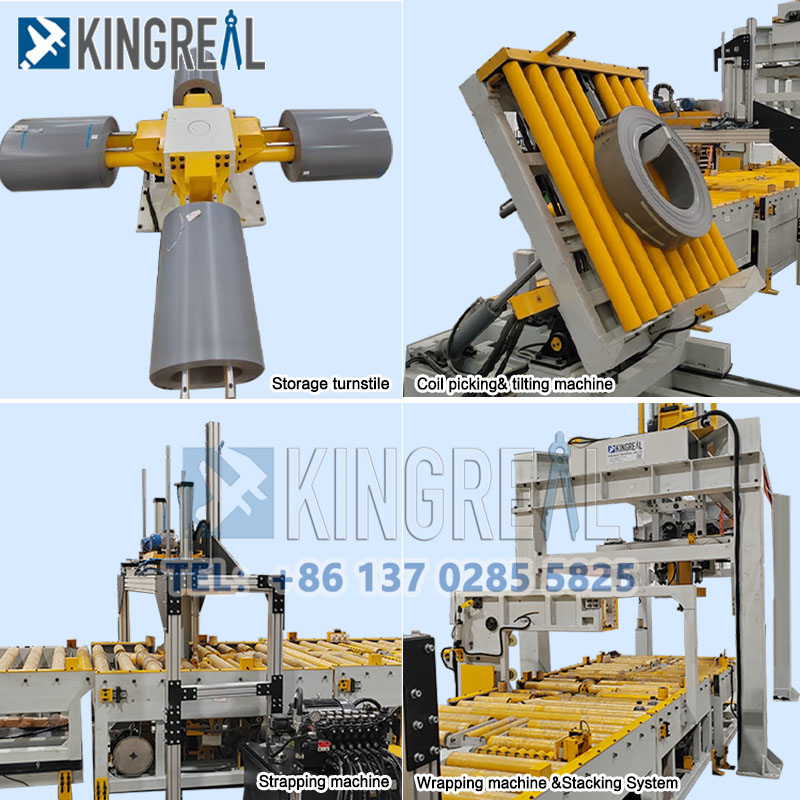
Large master metal coils required for processing are stored on the equipment's dedicated cross-type turnstile coil-storage arm. With a high load-bearing capacity, this cross-type turnstile coil-storage arm can store up to four master coils simultaneously, effectively preventing production downtime caused by material shortages and ensuring continuous operation.
02 automatic coil retrieval and upending.
The coil tipper tilter machine features an automatic retrieval and upending mechanism that precisely separates master coils from the rack and loads them sequentially, while simultaneously performing a 90-degree upending operation. This process replaces hazardous manual lifting and turning tasks, perfectly synchronizing with the metal slitting line's output pace and aligning the coil's orientation for subsequent standardized packaging.
03 weighing and automatic labeling.
Once upended, the slit coil is smoothly conveyed via roller tracks to the weighing station, where the steel coil packaging line automatically performs precise weight measurement. It also features an integrated smart print-and-apply labeling system that automatically prints weight information labels and applies them; this is an optional configuration that enterprises can enable flexibly based on production needs.
04 automated strapping and securing.
After labeling, the slit coils automatically enter the steel coil strapping machine of the slitting coil package line. The equipment automatically performs four precise strapping operations, firmly securing the coil structure to prevent loosening or deformation. The machine is compatible with various strapping consumables—specifically PP and PET straps, which are the industry standards. By configuring the production line with dual strapping heads (one for PP and one for PET), enterprises can freely switch between strapping modes to meet the packaging requirements of slit coils with different materials and specifications.
05 centering and alignment during transport.
During long-distance material transport, slit coils are prone to drifting or shifting due to uneven forces, which can affect subsequent packaging accuracy. To address this, the production line includes a dedicated centering process; a smart centering mechanism corrects the coil's position in real-time, ensuring stable, centered transport.
06 fully automated stretch wrapping.
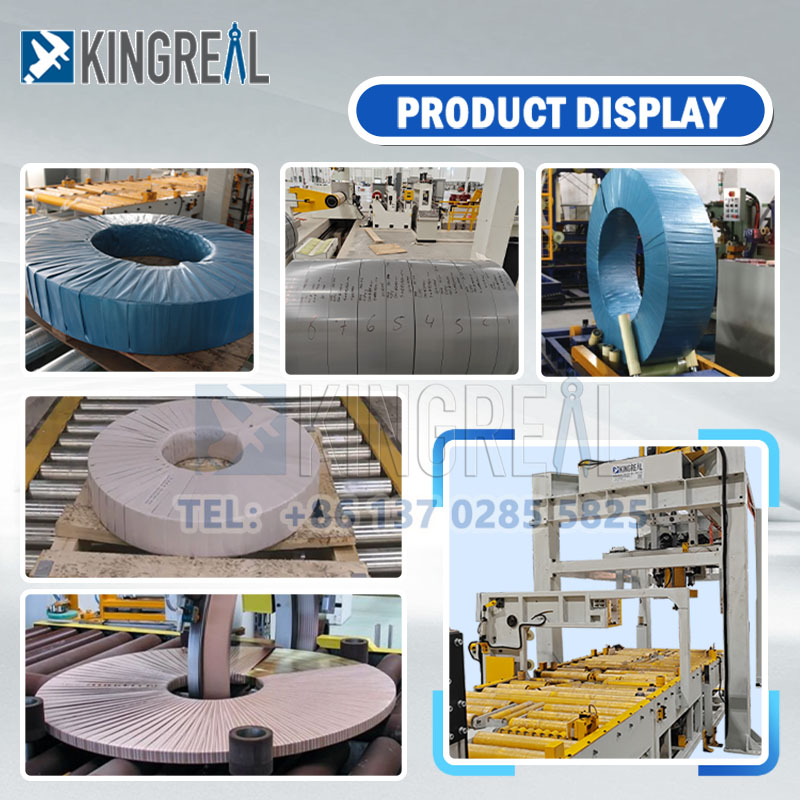
The aligned slit coils are precisely transported to the packaging station, where the machine automatically positions and secures the coil, locks the strap end, and initiates the fully automated stretch wrapping process. Packaging materials—such as stretch film and anti-rust film—can be flexibly selected based on the product's intended use, transport environment, and anti-rust requirements.
07 secondary centering and alignment.
After stretch wrapping, the strap tail is manually secured, and the equipment smoothly conveys the coil downward while initiating a secondary precision centering process. This further corrects the coil's position, ensuring a uniform and standardized packaging appearance for every coil.
08 automated stacking and storage.
Following secondary centering, qualified slit coils automatically proceed to the downstream stacking station for standardized stacking. Stacking modes can be customized; the basic mode allows for direct floor stacking, or the steel coil packaging line can interface with the client's existing conveyor lines to automate the transfer of finished goods into storage, accommodating various factory layouts.
09 final transfer of finished goods.
Once the complete packaging and stacking process is finished, forklifts transport the neatly stacked finished slit coils to the warehouse, marking the conclusion of the entire automated workflow—from slitter discharge to packaging and stacking.
Key Benefits of Slitting Coil Package Lines Paired with Steel Slitting Line
1
Zero-Damage Delivery
The integrated production line, combining the automated slitting coil package line and the metal slitting line, serves as the final critical line of defense for quality control in metal processing enterprises. Unlike traditional manual wrapping, the automated packaging process offers precise control and uniform tension, providing comprehensive protection for the mirror-like surfaces and sharp edges of the slit coils.
Even after long-distance sea or land transport and multiple transfers, the products retain their high-precision appearance and performance upon unpacking. This completely eliminates quality issues such as scratches, rust, dents, and deformation, ensuring zero-damage delivery.
Additionally, the steel coil packaging line is designed to withstand harsh environmental conditions—such as high humidity and rain—using specialized anti-rust packaging techniques to effectively prevent corrosion during long-distance transport.
2
Labor Savings
Traditional slit coil packaging is labor-intensive and hazardous; a single production line typically requires 3–5 workers for continuous operation.
Manual packaging involves heavy physical exertion and risks workplace injuries, such as cuts from steel strips or impacts from heavy loads. Integrating an automated packaging machine eliminates repetitive manual labor, significantly freeing up the workforce.
Furthermore, the slitting coil package line boosts packaging efficiency by over 60%, perfectly matching the high-speed output of the slitter. This resolves production bottlenecks and enables standardized, safe workshop operations.
3
Facilitating the Upgrade to Industry 4.0
The "coil-to-pack" automated system—featuring the collaborative operation of the steel slitting line and steel coil packaging line—enables unmanned, intelligent workflows covering slitting, conveying, weighing, packaging, and stacking.
With full data traceability and process control, this system transforms traditional, crude production models, helping enterprises rapidly upgrade to intelligent Industry 4.0 manufacturing while enhancing workshop automation and core competitiveness.
To learn more about optimizing the synergy between slitting coil package lines and steel slitting lines, or to set up a fully automated "coil-to-pack" production line, please contact KINGREAL for a customized solution!